For classroom use, I would use this as a Literacy lesson in unison with geographical and cultural studies. As a pre-activity, students could write their own poem about something they know well from where they live or what they see every day. After reading the poems, we could have the students draw relationships that they make with their poetry and the poems from around the world. When they find one that they can relate to, they could write about why they feel strongly for the poetry, and create their own picture to describe the poetry. I would say this book is more fit for 7-12 year old readers, but it could be used in most classrooms that are practicing a poetry unit.
This will become a place to reflect on children's literature, and a place to share favorite books, authors, or any literary work from just about anywhere.
Showing posts with label Poetry. Show all posts
Wednesday, April 27, 2011
Come to the Great World, Poems from Around the Globe
This is a collection of beautiful poetry written by children from all around the world. Some poems followed a rhyming pattern, while others were lengthier using descriptive language. All of the poetry expressed an individual joy or experiences that come from their lives and their lifestyles, which is where we learn about the different cultures and values. I was absolutely impressed by the depth of the words teamed with bright and colorful illustrations, and I do think that this is another book that should be in everyone's classroom--especially while a classroom learns about the components of poetry. We used this book in class when studying units of poetry, and I loved that the children were the authors and that they all came from different backgrounds. As the children are the real authors, the poems in this story were selected by Wendy Cooling, who has edited short stories of Roald Dahl, and in this book she works with Shiela Moxley, a world-traveling painter who studies different cultures from all around the world.

For classroom use, I would use this as a Literacy lesson in unison with geographical and cultural studies. As a pre-activity, students could write their own poem about something they know well from where they live or what they see every day. After reading the poems, we could have the students draw relationships that they make with their poetry and the poems from around the world. When they find one that they can relate to, they could write about why they feel strongly for the poetry, and create their own picture to describe the poetry. I would say this book is more fit for 7-12 year old readers, but it could be used in most classrooms that are practicing a poetry unit.
Tuesday, April 26, 2011
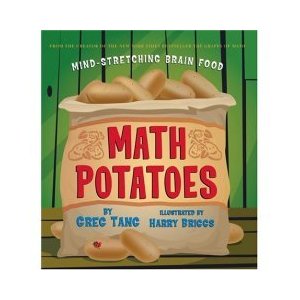
Math Potatoes: Mind Stretching Brain Food
What a cool book. I greatly dislike math and all of it's confusion, however math poetry? Where was this 15 years ago when math was NO fun to me!? Math Potatoes was created by Greg Tang, a Harvard graduate and an NYU graduate of Mathematics Education, ans he believes deeply in problem solving to keep our brains healthy. Each page was so creatively written, either hiding math messages in lines of poetry, or actively telling to seek out math elements within the Harry Brigg's illustrations. I stole this book from my Mom's classroom library, which tells me that it's actually Kindergarten safe, however it may be more geared for student ages 6-10. Greg Tang has created a Math series for all age levels, and at some point I would like to collect all of his books.
This book could be used for kids who struggle with math, yet seem to be stronger in reading and writing. Word problems are usually this kind of kid's best friend when it comes to math, and the numbers not always making sense in conjunction with the words that do fit the bill seem to be a helpful way to ease math into math-phobic students. As a pre-lesson, I would have students flip through the pages and find one puzzle to solve individually. In a small group, students could then check each other's answers in the back of the book to see how they did with the puzzle. If they didn't solve the problem correctly, the corrector could help show the student how to solve the problem. As a post-activity, the students could create their own math poem, creating a question within their riddle. This book definitely made math more fun, and I'm still mad that I didn't know about this book sooner!
Subscribe to:
Posts (Atom)